Cornhole is one of the most approachable and universally loved outdoor games. It crosses age groups, skill levels, and social boundaries, which is why it has become a staple in parks, schools, resorts, breweries, campgrounds, apartment communities, and public plazas.
But when cornhole boards are intended to live outdoors full-time, the conversation shifts from portability and price to durability, permanence, and long-term performance.
This guide focuses on one clear distinction: temporary boards versus permanent outdoor installations — and why concrete cornhole boards are purpose-built for public spaces where games must endure weather, crowds, and real-world abuse.
THE REALITY OF PERMANENT CORNHOLE INSTALLATIONS
Most cornhole boards on the market were designed for controlled environments. Backyards. Tailgates. Covered patios. Events where boards are set up, played on, and put away.
Permanent outdoor installations introduce a completely different set of demands.
Boards are exposed to sun, rain, snow, and freeze-thaw cycles. They are climbed on by kids, rolled over by bikes, tested by skateboards, and left unattended for long stretches of time. They must resist theft, movement, and vandalism while still delivering consistent play.
Permanent spaces require materials that don’t need protection from the environment — materials that belong there.
WOOD CORNHOLE BOARDS: TRADITIONAL BUT TEMPORARY
Wood cornhole boards are the classic standard and offer great playability in the right setting.
They perform well indoors or in covered outdoor areas where moisture and sun exposure are limited, and where boards can be stored after use.
In permanent outdoor environments, however, wood struggles. Warping, swelling, delamination, rot, peeling graphics, and splintering edges are common. Even high-quality plywood boards eventually fail when left exposed year-round.
Wood boards also remain lightweight and portable, making them susceptible to theft or relocation in public spaces.
Wood works best when permanence is not required.
PLASTIC CORNHOLE BOARDS: WEATHER RESISTANT BUT IMPACT VULNERABLE
Molded plastic cornhole boards are often marketed as weatherproof alternatives, and in some ways they are.
They resist moisture and won’t rot, making them suitable for casual outdoor use. However, plastic boards introduce new problems in permanent installations.
Flexing, cracking from impacts, UV brittleness over time, and poor resistance to skateboards and bikes limit their lifespan in public spaces. Like wood, plastic boards are still lightweight and easily moved or removed.
Plastic survives rain, but it does not thrive under sustained public use.
STEEL AND ALUMINUM CORNHOLE BOARDS: STRONG BUT COMPROMISED
Metal cornhole boards bring structural strength and improved weather resistance compared to wood or plastic.
They are heavier, more secure, and less prone to theft. However, they introduce tradeoffs in play experience and aesthetics.
Metal surfaces can be loud, retain heat in direct sun, dent over time, and feel unforgiving during play. Slide speed often requires coatings, and the industrial look does not always complement parks or landscaped environments.
Metal boards can work in select installations, but they often compromise either playability or design integration.
CONCRETE CORNHOLE BOARDS: DESIGNED FOR PERMANENT PUBLIC PLAY
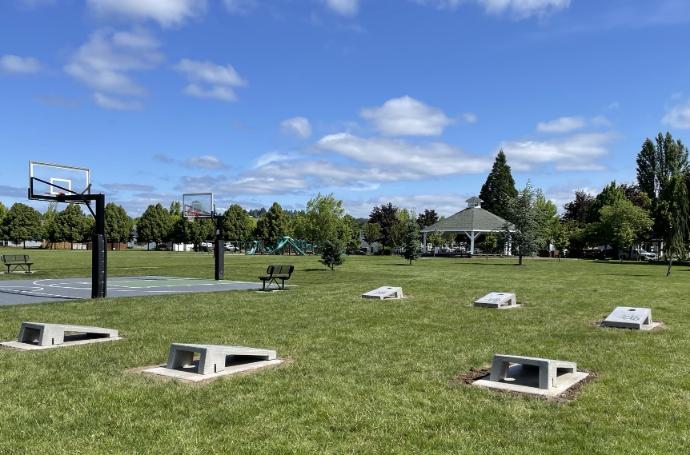
Concrete cornhole boards are not adapted from backyard designs. They are engineered from the ground up for permanent outdoor installation.
Concrete resists UV exposure, moisture, freeze-thaw cycles, and physical abuse. It does not warp, rot, flex, or delaminate. Bikes, skateboards, climbing kids, and heavy foot traffic do not shorten its lifespan.
Our concrete cornhole boards are designed with integrated bolt-down brackets and hardware, allowing them to be securely anchored to concrete pads or footings. Once installed, they stay put — eliminating theft, movement, and seasonal removal.
This level of permanence makes concrete cornhole boards ideal for parks, schools, resorts, campgrounds, HOAs, apartment communities, and civic spaces where reliability matters.
DESIGN STYLES: BUILT TO FIT THE SPACE
Permanent installations deserve thoughtful design. Our concrete cornhole boards are available in multiple styles to suit different environments and architectural preferences.
Standard Style
A classic, balanced design that fits seamlessly into parks, campuses, and community spaces. This is the workhorse option — familiar, timeless, and universally approachable.
Cantilever Style
A more architectural, modern profile that appeals to designers and landscape architects. The cantilever form creates visual interest while maintaining the same durability and play characteristics as our standard boards.
3-Hole Bean Bag Toss
A variation on traditional cornhole that adds multiple scoring targets and increased challenge. Ideal for spaces looking to introduce variety while maintaining a permanent, durable installation.
Each style is engineered with the same focus on stability, longevity, and public-space performance.
COLORED CONCRETE AND SURFACE FINISH OPTIONS
Concrete does not have to mean gray — unless gray is exactly what you want.
Our cornhole boards are available in a range of integrally colored concrete options, allowing the color to run through the material rather than sit on the surface. This ensures long-term color consistency even under heavy use.
Surface finishes can be tuned for both durability and playability. In addition to standard finishes, polished aggregate is available as an option, offering a refined appearance and a smooth, consistent bag slide without sacrificing durability.
These finishes are designed to age gracefully, maintaining both appearance and performance over time.
GRAPHICS PACKAGES: BRANDING THAT LASTS
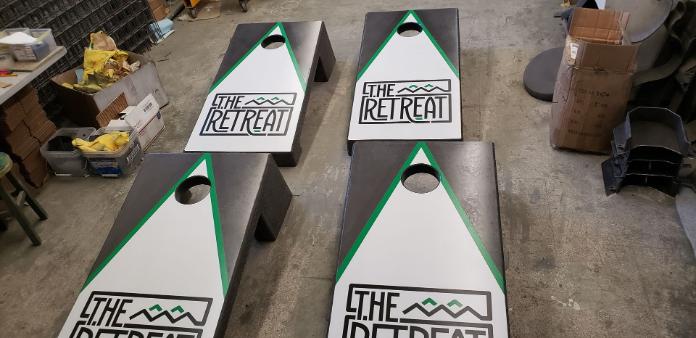
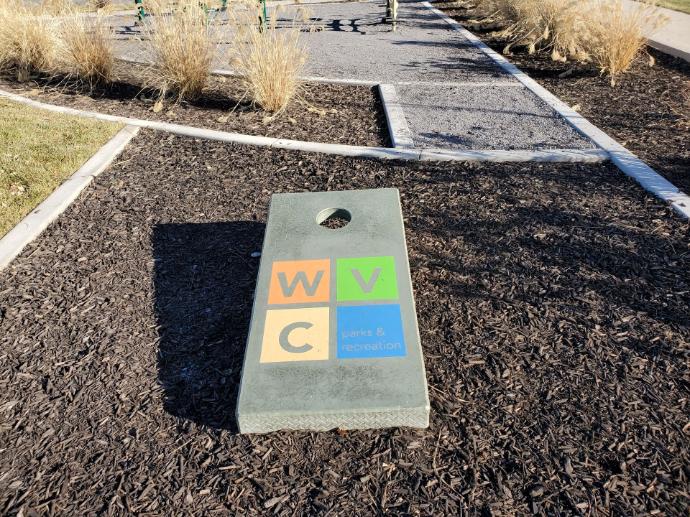
Graphics are where permanent cornhole boards truly become place-specific.
We offer a wide range of graphics packages designed specifically for outdoor, permanent installations. Logos, text, and visual elements are applied with durability in mind, ensuring they hold up under sun exposure, weather, and heavy public use.
Parks use graphics to reinforce identity. Resorts and breweries use them to extend brand presence outdoors. Schools and communities use them to create pride and ownership in shared spaces.
Because the boards themselves are permanent, the graphics become a lasting part of the environment — not temporary signage, but functional art that invites play.
With an extensive library of completed projects and graphic applications, nearly every design vision can be supported.
PORTABLE VS PERMANENT: A CRITICAL DISTINCTION
Trying to adapt portable cornhole boards for permanent outdoor use almost always leads to frustration. Added weights, chains, or improvised anchors rarely solve the underlying problem.
Permanent installations require materials and designs that assume exposure, abuse, and time.
Concrete does not need to be protected from the environment. It is part of it.
BUILD ONCE. PLAY FOR DECADES.
Concrete cornhole boards are not about trends or novelty. They are about longevity, stability, and confidence — knowing that once installed, the game will still be there years later, inviting play without maintenance, storage, or replacement.
For permanent outdoor spaces, concrete is not just an option. It is the standard.