Intergenerational Play, Pocket Park Activations, and the Rise of Outdoor Community Centers
Public spaces don’t come alive because they’re large.
They come alive because they’re loved.
A bench can invite someone to rest.
A shade tree offers relief.
A mural can spark a smile.
But a well-placed concrete game table—even something as simple as Connect Four, box hockey, dominoes, or backgammon—does something different. It creates interaction. It anchors a corner. It transforms a quiet space into a shared space. It becomes a micro-placemaker, a catalyst for the everyday rhythms of community life.
Stone Age’s iconic pieces—4-way ping pong, shuffleboard lanes, Chinese checkers, and our full lineup of concrete table games—were born from a simple truth:
Play is the fastest way to turn strangers into neighbors.
1. The Rise of Micro-Placemakers: How One or Two Game Installations Change Everything
For years, cities and designers focused heavily on large amenities: big playgrounds, splash pads, sports courts. These matter—but they don’t touch every demographic, and they don’t activate the smaller spaces that make up most parks, trails, campuses, and multifamily communities.
This is where micro-placemaking thrives.
Learn More About Placemaking With Concrete Games
The Ultimate Guide to Outdoor Concrete Games
A Concrete Connect Four
can activate a forgotten corner!
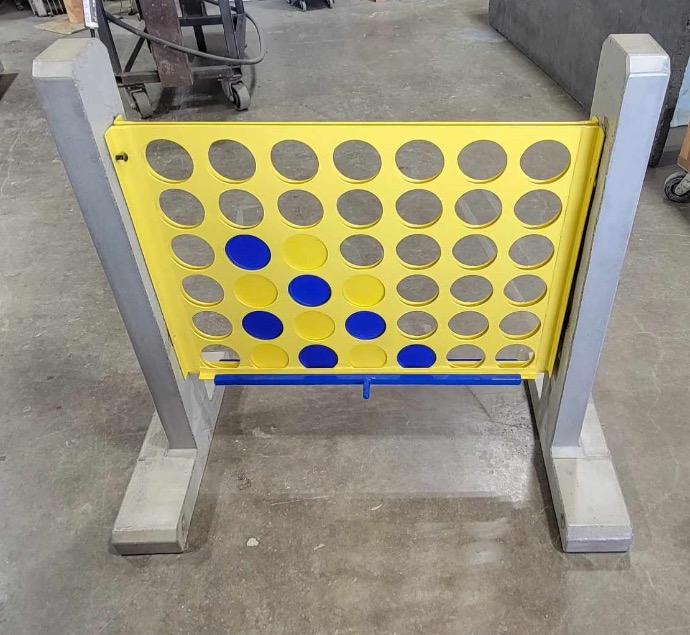
Kids run toward it first. Parents drift in behind them. Grandparents stand close enough to watch. Suddenly the quiet space is awake.
A simple concrete domino or backgammon table becomes a social magnet for adults and seniors.
People linger. Conversations form. Daily rituals develop.
These games don’t just entertain—they anchor.
A box hockey court turns a blank sidewalk zone into a kinetic youth hub.
It’s fast. Loud. Eye-catching. Teens gravitate toward it without instruction or pressure.
Micro amenities work because they don’t require programming, reservations, staffing, or special equipment. They work every day, in every season, for every passerby.
They turn leftover space into lived-in space.
2. Intergenerational Play: The Hidden Power Behind These Simple Games
Placemaking isn’t just about designing spaces—it’s about designing social collisions.
Few elements create intergenerational interaction as naturally as concrete game tables.
Children & Families
- Connect Four becomes a “first independent game” for small children.
- Chinese checkers introduces simple strategy.
- Shuffleboard offers a low-intensity, no-contact game that kids can play with grandparents.
- 4-way ping pong draws multigenerational crowds who want to take a turn.
Teens & Young Adults
- Box hockey provides fast physical play without the formality of a sport court.
- 4-way ping pong is chaotic, competitive, and effortlessly shareable on social media.
- Dominoes and backgammon challenge strategic thinking and social interaction at a time when many teens are searching for offline connections.
Adults
- Backgammon, dominoes, and Connect Four create low-stakes play that fits naturally into lunch breaks, evening walks, or community gatherings.
- Shuffleboard brings nostalgia and a sense of “play without sweat.”
Seniors
- Domino tables are often the first amenity adopted by a senior community.
- Shuffleboard offers long engagement time with little physical strain.
- Backgammon becomes a daily ritual—something familiar, stable, and social.
- Concrete Ping Pong Tables get a lot of use from seniors and other age groups the activity levels of ping pong range from low movement cooperative rallies all the way up to full blown Olympic competition! It’s perfect for both the very active as well as those with more limited range of movement and activity.
Placemaking research consistently shows:
Spaces that appeal to multiple ages at once stay active longer and feel safer, more inclusive, and more memorable.
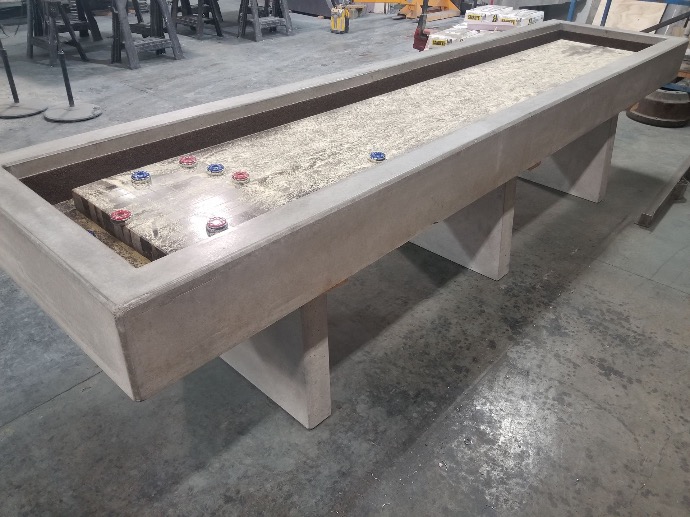
Concrete Shuffleboard
Anchors an outdoor space’s innovation and playfulness with beautiful craftsmanship and decades of fun!
3. Pocket Parks: Small Spaces, Big Community Energy
Pocket parks are the workhorses of modern urban design.
They don’t have the square footage for courts or playgrounds—but they do have room for one or two iconic pieces.
Enter the micro-placemaker.
A sidewalk nook or pocket park with:
- One concrete Connect Four
- A few table games like a Backgammon table, Dominos, chess or Chinese Checkers.
- One box hockey game.
…will outperform a pocket space with only benches every time.
Why?
Because people may walk past a bench—but they stop for play.
Pocket parks that include small concrete games consistently report:
- Higher dwell time
- More cross-demographic use
- Better perceived safety
- More foot traffic for surrounding businesses
- Stronger neighborhood identity
You’re not installing “a game.”
You’re installing a reason for people to stay awhile, to interact and to put down their phone.
4. Community-Center Play Areas: The Outdoor Living Room Model
While micro-placemaking happens with one or two game pieces, the next level is what we call ann Outdoor Community Center—a cluster of durable, permanent, high-engagement play tables arranged with intention.
These installations may combine:
- 4-Way Concrete Ping Pong
- Standard Ping Pong
- Connect Four
- Shuffleboard
- Dominoes
- Backgammon
- Box Hockey
- Chinese Checkers
- Seating walls and shade elements
This mix creates a village square effect.
People wander in.
People mill around.
People join a game they weren’t planning to play.
The beauty of a Stone Age installation is that it is not “programmed recreation.”
It is informal recreation:
self-directed, spontaneous, and self-sustaining.
In an outdoor community center setting, each game plays a specific role:
- Ping Pong & 4-Way Ping Pong: High-visibility anchor pieces that draw teens, adults, and spectators.
- Dominoes & Backgammon: Provide slower-paced engagement and long dwell time.
- Connect Four & Chinese Checkers: Family-friendly pieces that activate the space early in the day.
- Box Hockey: Injects energy and movement without needing a full court.
- Shuffleboard: Appeals to all ages and creates multi-hour engagement.
Together, they create a multi-sensory play environment that feels alive, day and night.
5. Why These “Small Games” Are Actually Giant Wins for Placemaking
Designers often focus on big statement pieces—but overlook the role of repeatable, durable, versatile amenities.
Concrete games offer:
1. Zero maintenance
No replacement parts, no weather worries, no staffing.
2. Cross-demographic appeal
Families, teens, seniors, tourists, locals—it works for all.
3. High activation per square foot
A domino table can outperform an entire lawn in terms of engagement.
4. Predictable behavior patterns
Game installations naturally deter negative behavior and attract positive use.
4-way ping pong, shuffleboard lanes, Connect Four—these become visual brand elements for parks and multifamily properties.
6. Extreme longevity
Stone Age designs—literally—measure success in tons, laughter, and centuries.
Your games stand longer than the buildings beside them.
6. The Future of Placemaking: Precision-Designed Public Joy
As cities densify and community life evolves, we are witnessing a shift:
Public spaces don’t just need amenities—they need anchors of joy.
Simple, durable, everyday-playful anchors.
Concrete games are not a luxury feature.
They are a strategy—a tool for stitching together communities, inviting intergenerational mixing, and transforming even the smallest public corners into micro-community centers.
Good placemaking doesn’t happen at the master-plan level.
It happens at the human level:
one game, one table, one moment of play at a time.
Stone Age installations across parks, schools, HOAs, resorts, multifamily developments, and waterfronts prove this every day.
When you install a concrete game, you’re not just adding recreation.
You’re creating a predictable moment of human connection.
And it lasts—literally—for generations.